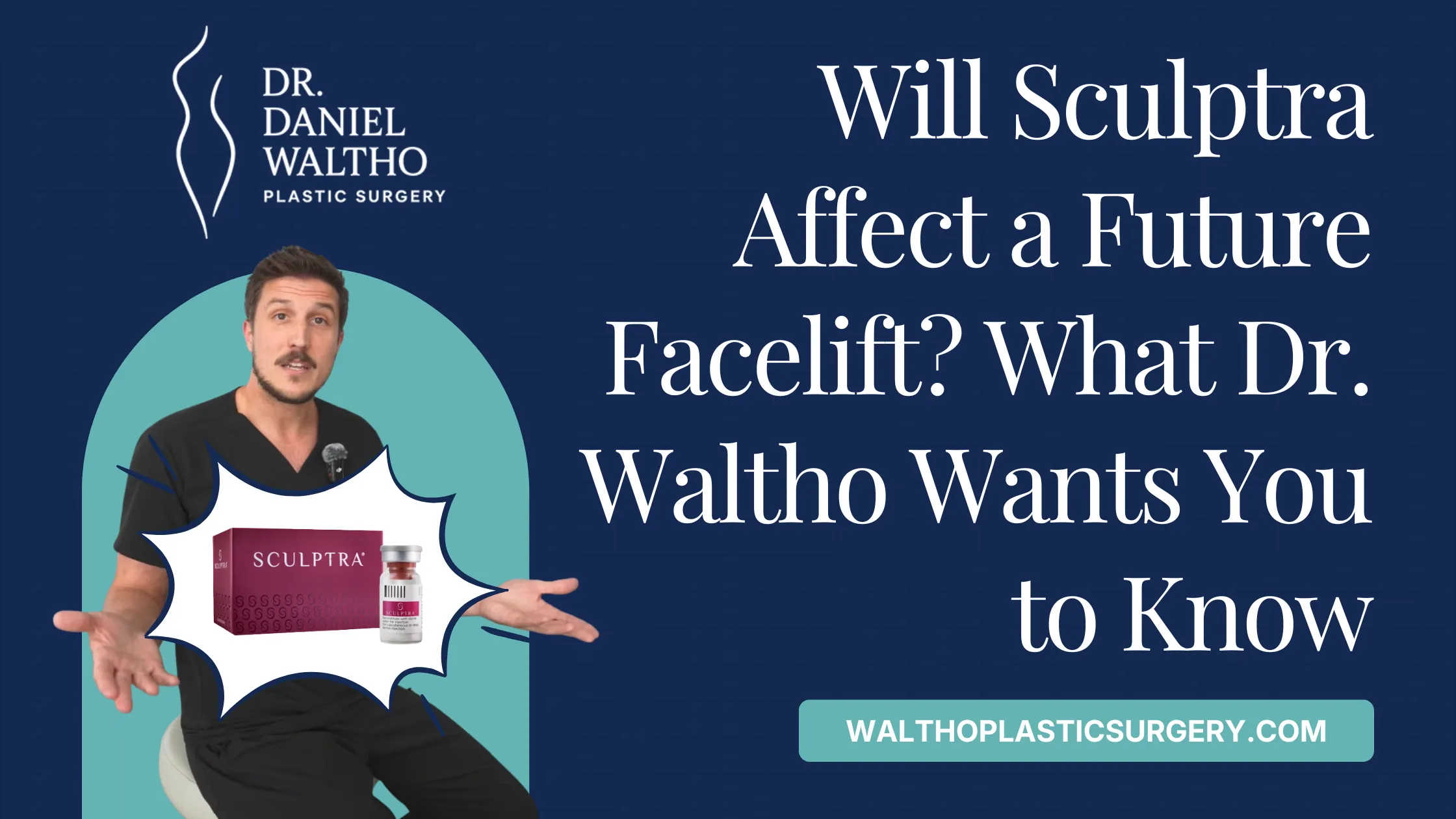
Using Sculptra can seriously affect your ability to get a facelift in the future. That is not a reason to avoid it, but it is a reason to think carefully before you start. Injectable biostimulators like Sculptra and Radiesse work by creating collagen, and the process that creates that collagen also creates scar tissue in exactly the layers a facelift surgeon needs to work in. Dr. Daniel Waltho, a board-certified plastic surgeon in Burlington who operates on faces regularly, has seen the difference firsthand.
How Biostimulators Are Different From Fillers
A traditional hyaluronic acid filler adds volume directly. You inject a gel, and the gel occupies space. Biostimulators work on a completely different principle. Sculptra is made of poly-L-lactic acid, and Radiesse is made of calcium hydroxylapatite microspheres. Neither one is there to fill anything long term. They are there to make your body build collagen.
The way they do that is by creating a foreign body reaction. Your body encounters something it does not recognize, mounts an immune response, and that inflammation results in collagen formation. Research describes the sequence precisely: plasma proteins adsorb onto the particles, monocytes infiltrate and differentiate into macrophages, those macrophages fuse into multinucleated foreign body giant cells, and fibroblasts are activated to synthesize collagen that eventually encapsulates the material (Journal of Clinical Medicine review, 2024).
The result is gradual, natural-looking volume that builds over months. That is genuinely appealing, and it is why these products have become so popular.
The Part That Does Not Make the Marketing Copy
Read that mechanism again and note the last word in the scientific description: fibrosis. Collagen deposition and scar formation are not two separate processes. They are the same process. The literature is explicit that the foreign body response to poly-L-lactic acid activates fibroblasts to synthesize collagen which encapsulates the polymer, leading to fibrosis (Journal of Clinical Medicine, 2024).
As one surgeon put it in Forbes, it is not effective marketing to highlight that these products cause inflammation or scarring, so the industry uses the word biostimulating instead (Forbes).
The problem is not the scar tissue itself. The problem is where it forms. These products are injected into the superficial and deep structures of the face, which are the same tissue planes a surgeon has to dissect during a facelift.
What This Looks Like in the Operating Room
A facelift depends on tissue planes separating cleanly. When a plane contains years of biostimulator-induced fibrosis, that normal tissue glide is reduced. The tissue does not come apart the way it should. Dissection becomes slower and requires sharper, more deliberate technique, and adhesions can tether skin to deeper structures, making flap elevation harder.
This is not just anecdote. A 2025 survey of 63 facial surgeons published in Aesthetic Plastic Surgery found the following among surgeons operating on patients previously treated with biostimulators (Avelar et al., Aesthetic Plastic Surgery, 2025):
| Surgeon-reported finding | Percentage |
|---|---|
| Reported difficulty with tissue dissection | 91.8% |
| Noted increased complication rates | 84.4% |
| Observed postoperative skin irregularities | 73.3% |
| Noted prolonged inflammation | 57.4% |
| Reported longer operative times | 50.8% |
| Adjusted their surgical approach, especially with fibrosis | 43.8% |
A separate online poll of 114 facial plastic surgeons found that 82% reported finding significant scarring in facelift patients who had previously used Sculptra or other biostimulators, and 79% said they worry about nerve injury and skin death when operating on patients who have had collagen-stimulating injectables (Allure).
It is worth noting that the picture is not unanimous. Some high-volume facelift surgeons report that prior biostimulator use requires more meticulous dissection but does not compromise the result, and Sculptra’s manufacturer, Galderma, has stated that to its knowledge the majority of Sculptra patients do not exhibit scarring (Allure). The research on this specific question is still developing.
Does That Mean Sculptra Is Bad?
Absolutely not. Sculptra is Health Canada approved and can be a fantastic treatment option for the right patient. For someone who wants gradual, natural volume restoration and is not considering surgery, it does exactly what it promises to do, and the collagen it builds is real.
The issue is not whether biostimulators work. It is whether the person recommending one has asked where you want to be in ten years. A treatment that is ideal for a 40 year old with no surgical plans is a different decision entirely for a 55 year old who is likely to want a facelift within a few years.
How to Think About Sequencing
If a surgical facial procedure is anywhere in your future, the sequence of treatments matters more than any single treatment. A few practical points:
- Tell every provider everything. Your surgeon needs a complete history of what has been injected, where, how much, and when. This is the single most useful thing you can do.
- Timing helps. Surgeons in the 2025 survey found procedures performed within six months of injection more challenging, and there is no consensus yet on an ideal interval.
- Volume and depth matter. Repeated large-volume sessions over years compound the effect. Conservative dosing at the correct depth carries less risk than aggressive treatment.
- Consider surgery first. For some patients, having the operation first and using injectables afterward for refinement is the cleaner sequence.
- Ask your surgeon before your injector. A surgical consultation costs you one appointment and can reframe the entire plan.
Frequently Asked Questions
Can you still get a facelift after Sculptra?
Yes. Prior Sculptra use is not a barrier to facelift surgery. It can make tissue planes firmer and dissection more difficult, which is why disclosing your full injectable history is essential. An experienced facial surgeon can plan around it, but the surgery may take longer and require more meticulous technique.
How long should I wait between biostimulators and a facelift?
There is no established consensus. The 2025 surgeon survey found procedures performed within six months of injection were considered more challenging, and many surgeons suggest spacing injectables and surgery by at least a year to allow inflammation to resolve and tissues to stabilize. Discuss your specific timeline with your surgeon.
Do hyaluronic acid fillers cause the same problem?
Generally no. Standard hyaluronic acid fillers add volume directly rather than provoking a sustained foreign body reaction, and they can be dissolved with hyaluronidase. The surgical concern is specific to collagen-stimulating products such as poly-L-lactic acid and calcium hydroxylapatite, and to thread lifts.
Is Sculptra approved in Canada?
Yes. Sculptra, made of poly-L-lactic acid and manufactured by Galderma, is Health Canada approved and legally available across Canada. Approval confirms safety and effectiveness for its intended use. It does not address how the treatment interacts with surgery you may want years later.
Should I stop considering injectables entirely?
No. The point is informed sequencing, not avoidance. Every aesthetic procedure involves trade-offs. The goal is to understand them before you start so that today’s treatment does not limit tomorrow’s options.
Every Procedure Has Trade-Offs. Understand Them First.
The reason this conversation matters is that most patients are never told there is a long-term dimension to a treatment that sounds entirely low-risk. Your injector and your surgeon should both be thinking about where you want to be in a decade, not just how you look next season.
Dr. Daniel Waltho, MD, FRCSC, is a board-certified plastic surgeon and an adjunct assistant clinical professor at McMaster University. He performs a full range of facial and body procedures from a private, accredited surgical facility in Burlington, serving Burlington, Oakville, Hamilton, Milton, Mississauga, and the Greater Toronto Area.
- Clinic: Appleby Plastic Surgery, 5045 Mainway, Unit 110, Burlington, Ontario L7L 5H9
- Phone: (905) 315-1711
- Hours: Monday to Friday, 8 AM to 5 PM
If you are considering biostimulators, or you have already had them and are thinking about facial surgery, book a consultation so we can map out a plan that protects your options.