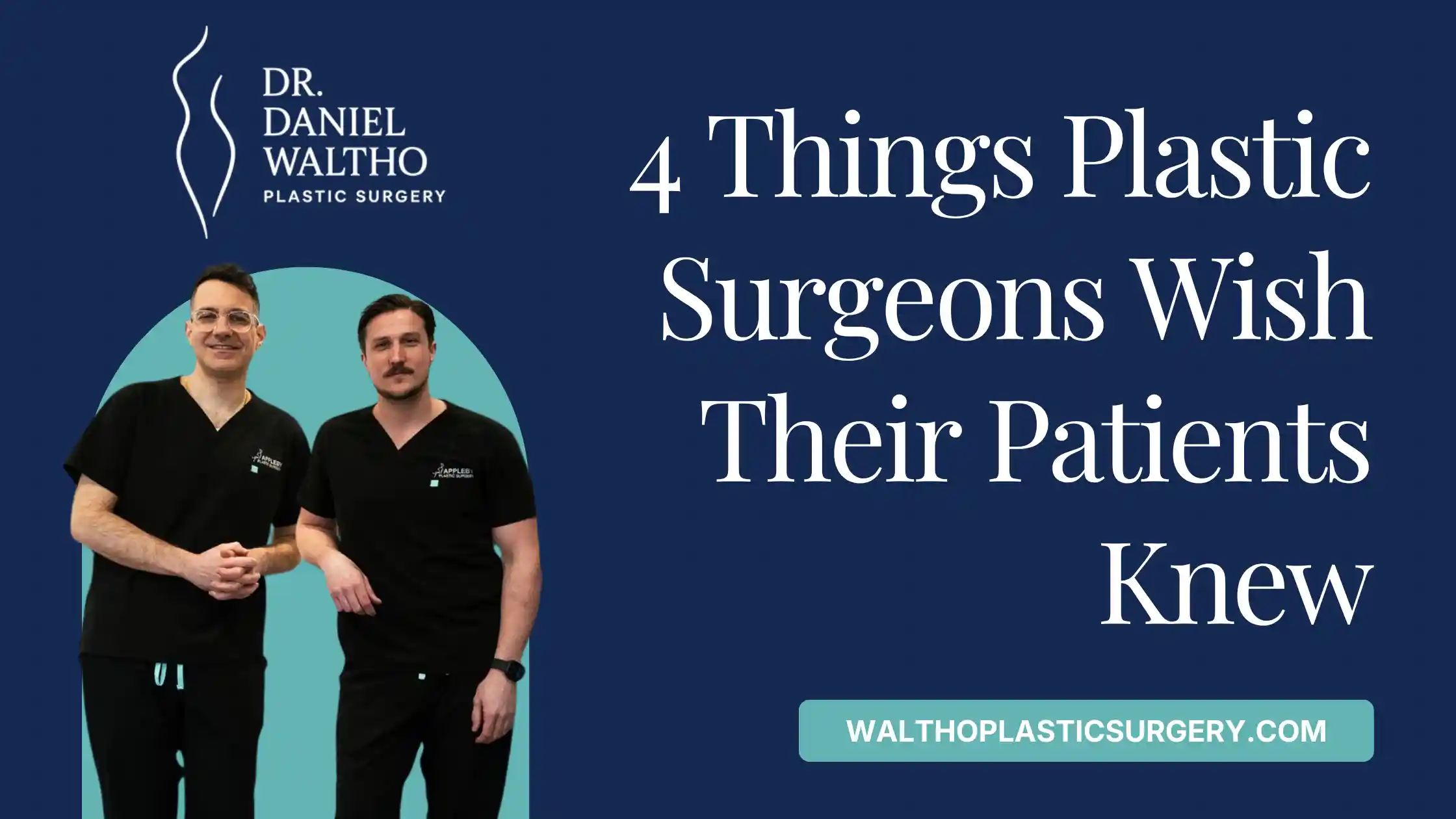
After enough consultations, every plastic surgeon ends up having the same four conversations over and over. They aren’t about technique or implant brands. They’re about expectations, and they’re the difference between a patient who’s happy at one year and a patient who was disappointed at week three. Dr. Daniel Waltho, a board-certified plastic surgeon in Burlington, put it into four points: a big result takes a big surgery, healing takes time, not everything needs surgery, and you can’t copy someone else’s result. Here’s what each one actually means when you’re sitting in the consultation room.
Key Takeaways
- The size of the result matches the size of the operation. A bigger change means a bigger procedure and a bigger investment of your time and energy in healing.
- Results arrive gradually. Scar maturation alone takes six months to a year, so the result you see at three weeks is not the result you keep.
- Surgery isn’t always the answer. Minimally invasive treatments outnumbered cosmetic surgical procedures by more than 17 to 1 in 2024, and some concerns aren’t surgical problems at all.
- You can’t copy another person’s result. Your skeleton and soft tissue set the range of what’s achievable, and a lot of inspiration photos were never real to begin with.
- Good planning is individual. The same goal can lead to different operations in two different patients.
4. A Big Result Takes a Big Surgery
There’s a trade-off nobody can engineer around. A big change needs a big operation, and that means a bigger investment of your time, your effort, and your own energy in healing. If you want a smaller result, you can have a smaller procedure. What doesn’t exist is the dramatic change with the two-day recovery.
This matters because marketing tends to promise the opposite. Lunchtime procedures, weekend recoveries, and minimal downtime are real categories, but they deliver proportionally smaller changes. When a patient wants their abdomen to look the way it did before two pregnancies, that’s a tummy tuck with muscle repair, not a treatment you fit in over a lunch hour.
The part of the investment that’s yours
Your surgeon controls the operation. You control a surprising amount of what happens afterward, and it isn’t passive. Healing well means:
- Taking real time off, not the minimum you can survive on
- Not smoking, which is one of the single biggest controllable risks to wound healing
- Eating and hydrating properly through recovery, since good nutrition, hydration, and reduced tension on incisions are among the most useful things a patient can do in the first two weeks (American Society of Plastic Surgeons)
- Following activity restrictions even after you feel fine, because feeling fine arrives well before tissue is strong
- Showing up for follow-up appointments so problems are caught early rather than explained late
Patients who plan for the recovery, not just the surgery date, tend to have a much easier experience. The operation is one day. The healing is your project.
3. Healing Takes Time, and the Result Comes Gradually
Swelling goes down. Scars mature. Neither happens on the timeline patients expect, and both are why judging a result too early is the most common source of unnecessary worry.
Scar maturation alone takes six months to a year, and it’s completely expected for a scar to look red and slightly textured before it flattens and blends with surrounding skin. Redness is a sign of healing rather than a problem, and a scar can look worse before it looks better (American Society of Plastic Surgeons).
The underlying tissue follows its own schedule. By 4 to 5 weeks after surgery, a scar has reached roughly 60 percent of the original strength of the skin, and complete maturation isn’t reached until about one year, when scar strength peaks at around 80 percent of original skin strength. This is also why surgical scar revision is generally considered only after maturation, since revising early carries an increased risk of recurrence and poor healing (Seminars in Plastic Surgery, 2021).
A realistic way to think about the timeline
- First two weeks: swelling and bruising are at their peak. Nothing here represents your result.
- Weeks 3 to 6: you start to look like yourself again and can usually return to most normal activity, with restrictions.
- Months 3 to 6: contour settles, most swelling is gone, scars are often still red.
- Six months to a year: scars soften and fade, and the result you’ll actually keep becomes clear.
Recovery details vary by procedure, so the stages listed on each procedure page are worth reading before you book. A facelift and a breast augmentation do not recover on the same schedule.
2. Not Everything Needs Surgery
Not every problem requires a big investment and a big operation. And just as importantly, operations cannot fix every problem. Both halves of that get lost in consultations where the patient arrives having already decided.
The volume data makes the first half obvious. In 2024, there were nearly 1.6 million cosmetic surgical procedures in the United States and over 28.5 million minimally invasive procedures, more than 17 times as many (American Society of Plastic Surgeons). Plenty of concerns are better matched to a smaller intervention, a staged plan, or watching and waiting.
The second half is harder to hear. Surgery changes anatomy. It doesn’t change how you feel about yourself on a bad day, it doesn’t stop aging, and it can’t undo every consequence of skin quality, genetics, or significant weight change. A surgeon who tells you that up front is doing you a favour. If an operation isn’t going to deliver what you’re actually after, the right answer is to say so, which is the same reason our approach to the consultation starts with how you want to feel rather than with a procedure name.
1. You Can’t Copy Someone Else’s Result
This is the big one. People have different anatomy and different facial and body structure, so the same goal can require different surgery in two patients, and can produce different results that suit each person. Bringing in a photo of someone else’s outcome and asking for that outcome skips over the one variable that can’t be changed, which is where you’re starting from.
Much of the shape of a face is skeletal. As Troy Pittman, MD, put it, “So much of our nose, jaw and chin are skeletal in nature. So, unless you’re going to start moving bones around, that’s kind of who you are” (American Society of Plastic Surgeons). Bone structure, skin thickness, tissue quality, and how you heal all sit underneath any result you admire.
There’s also the question of whether the photo was ever real. Most images in magazines and on social media have been altered in some way, whether through editing apps, retouching, or professional lighting, and that includes the photos that look candid. AI-generated inspiration images have made this harder again, producing faces with near-perfect symmetry and proportions that don’t occur in real anatomy. Some degree of asymmetry is normal and often contributes to a person’s appearance, and chasing perfect symmetry can produce results that look less natural, not more (American Society of Plastic Surgeons).
How to use inspiration photos well
Photos aren’t useless. They’re just evidence of preference rather than instructions. They work best when they help your surgeon understand what you like:
- Bring several images rather than one, so the pattern in what you like becomes clear
- Point to the specific element you respond to, such as upper breast fullness or a flatter lower abdomen, instead of the whole person
- Bring examples of results you don’t want, which are often more informative
- Prefer real before and after photos of patients with a similar starting point over celebrity or influencer images
- Ask directly whether that element is achievable on your anatomy, and what it would take
The most useful images communicate specific goals rather than a demand to look like another person. From there, a surgeon can tell you how that element might look on your anatomy, and whether it’s even surgically feasible.
Putting These Four Things to Work in Your Consultation
If you’re preparing for a consultation, these four points turn into a short list of questions worth asking:
- Given my goals, how big an operation are we actually talking about, and is there a smaller option?
- How much time off do I realistically need, and what will I be unable to do during that time?
- When will I see the near-final result, and when do scars typically settle?
- Is there a non-surgical option that would get me part of the way there?
- Looking at my anatomy, which parts of my goal are achievable and which aren’t?
- What would you advise against in my case, and why?
Dr. Daniel Waltho is a board-certified plastic surgeon with an FRCSC in Plastic Surgery, a staff plastic surgeon at Oakville Trafalgar Memorial Hospital, and an adjunct assistant clinical professor at McMaster University. He operates from Appleby Plastic Surgery, a private accredited surgical facility in Burlington, and consults across breast, body, and facial procedures. You can read more about his training on the about Dr. Daniel Waltho page.
Frequently Asked Questions
Why can’t I get a dramatic result from a minor procedure?
The size of a result is tied to how much tissue is changed. Larger changes require removing, repositioning, or repairing more tissue, which means a longer operation and a longer recovery. Smaller procedures deliver proportionally smaller improvements, which is often exactly the right choice.
How long until I see my final plastic surgery result?
Most swelling resolves over the first several weeks to a few months, but scar maturation takes six months to a year, and scar strength peaks at about one year. Expect to see a near-final result in the three to six month range, with scars continuing to fade past that.
Is it normal for a scar to look worse before it looks better?
Yes. A healing scar is often red and slightly raised for several months, sometimes up to half a year, because of increased blood flow and new collagen. That redness is part of normal maturation. Scars that are not improving by six months should be assessed by your surgeon.
Should I bring a photo of the result I want to my consultation?
Bring several, and treat them as a way to communicate preferences rather than a target to be copied. Point out the specific feature you like. Your surgeon can then explain how that element might look on your anatomy and whether it’s achievable.
What if my surgeon says I don’t need surgery?
Take it as a good sign. Not every concern is a surgical problem, and surgery can’t solve every problem. A surgeon who declines to operate, suggests a smaller procedure, or recommends waiting is prioritizing your outcome over the booking.
Let’s Have the Honest Conversation
The best consultations are the ones where nothing gets oversold. Bring your goals, your questions, and your photos, and leave with a plan built around your anatomy and your life.
Clinic: Appleby Plastic Surgery, 5045 Mainway, Unit 110, Burlington, Ontario L7L 5H9
Phone: (905) 315-1711
Hours: Monday to Friday, 8 AM to 5 PM
Contact us today to book your consultation with Dr. Waltho and find out what’s realistic for you.